A Hannya mask tattoo depicts a figure from Japanese Noh theater: a woman transformed by jealousy and grief into a demon. It reads as rage and sorrow at the same time, which is why people choose it. Most are done in black and gray, run large enough to hold detail, and sit on the arm, thigh, or back.
TLDR:
- The Hannya is a Noh theater mask representing a woman consumed by jealousy, and it carries sorrow as much as anger.
- The face is built to read two ways depending on the angle, which is the whole point of the design.
- Black and gray suits it best, though color work is a real option for a bolder piece.
- Give it room. Horns, fangs, and expression need size to stay readable as the tattoo settles.
- Common placements are outer arm, thigh, calf, and back.
- It pairs naturally with other Japanese elements such as koi, waves, and peonies.
We tattoo a lot of Japanese work in Denham Springs, and the Hannya is the request that comes with the most story attached. People rarely want it just because it looks good. They want it because the meaning fits something.
What the Hannya Mask Actually Represents
The Hannya mask holds a specific place in Japanese culture. It represents a woman driven by jealousy and rage into something no longer human, and it appears in Noh theater to show that transformation on stage.
Sharp horns, bulging eyes, and a wide grin make it frightening. What makes it last as a tattoo is the second reading underneath. Tilted down the face looks sorrowful. Tilted up it looks furious. The carver built both into one object, and a good tattoo keeps that ambiguity intact.
If the meaning matters to you, say so at the consultation. A Hannya drawn as pure horror looks different from one drawn with the grief still in it, and that decision changes the linework before anything touches skin.
Black and Gray or Color
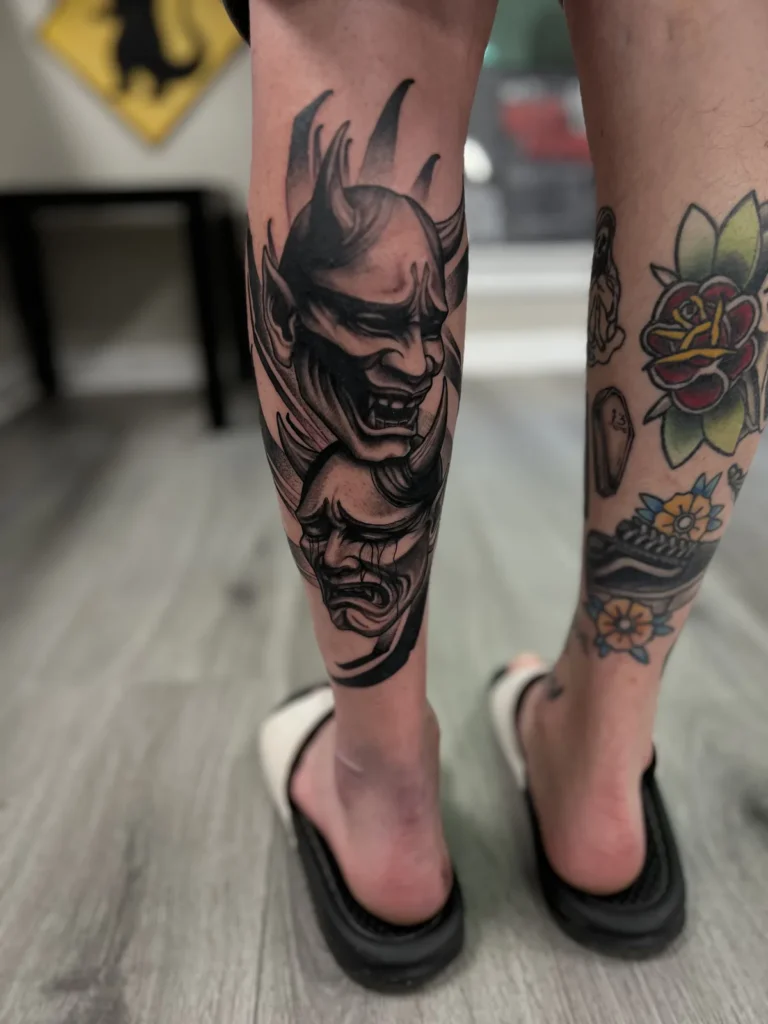
Most Hannya pieces are black and gray. Shading carries the expression, the horns and fangs stay sharp, and the face keeps working as the tattoo softens over the years. It is also the style our artists do most.
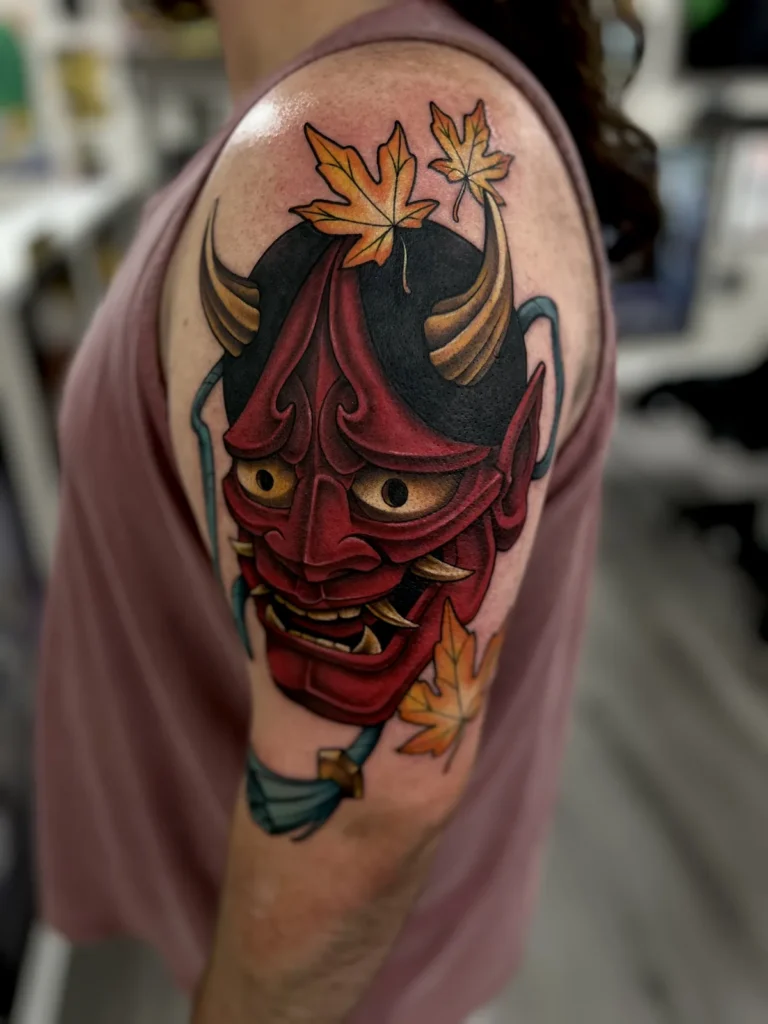
Color is a legitimate choice and changes the character of the piece. Traditional Hannya masks are often red or deep crimson, which pushes it toward anger and away from sorrow. Neither is more correct. They are different tattoos.
Size and Placement
This design punishes going too small. Horns, teeth, and the shape around the eyes all need space, and a Hannya crowded onto a small area loses the expression that made it worth getting.
Outer arm, thigh, calf, and back all give it the room it needs. It also sits well as part of a larger Japanese piece, working alongside koi, waves, or peonies rather than standing alone. That is worth planning before the first session if a sleeve is where this is heading.
Common Questions About Hannya Mask Tattoos
These come up most often when someone books a Hannya piece with us. Bring the rest to your consultation.
Is a Hannya mask tattoo disrespectful?
It is a widely tattooed motif with a long history in Japanese art, and wearing one is generally not treated as appropriation. Understanding what it means before you commit matters more than anything, which is part of what a consultation is for.
How long does one take?
A standalone black and gray Hannya on the arm or calf is usually a single long session. Larger pieces, or a Hannya built into a sleeve, run across multiple sittings. You get a realistic estimate before booking rather than partway through.
Can it cover an existing tattoo?
Often yes. The heavy black and dense shading make it one of the better cover-up subjects. What is already there decides how much freedom the design has, so bring a photo and we will tell you honestly through our cover-up work.
Do I need a reference?
Bring anything that caught your eye, but do not feel you need a finished design. Drawing it for your body and your placement is part of the custom design process.
Thinking about a Hannya piece? Bring your references and your placement and we will talk through size, style, and how many sessions it needs. Call or text if that is easier than a form.